Start with your physical space
Physical accessibility is the most visible barrier and often the most straightforward to address, though it may require some investment.
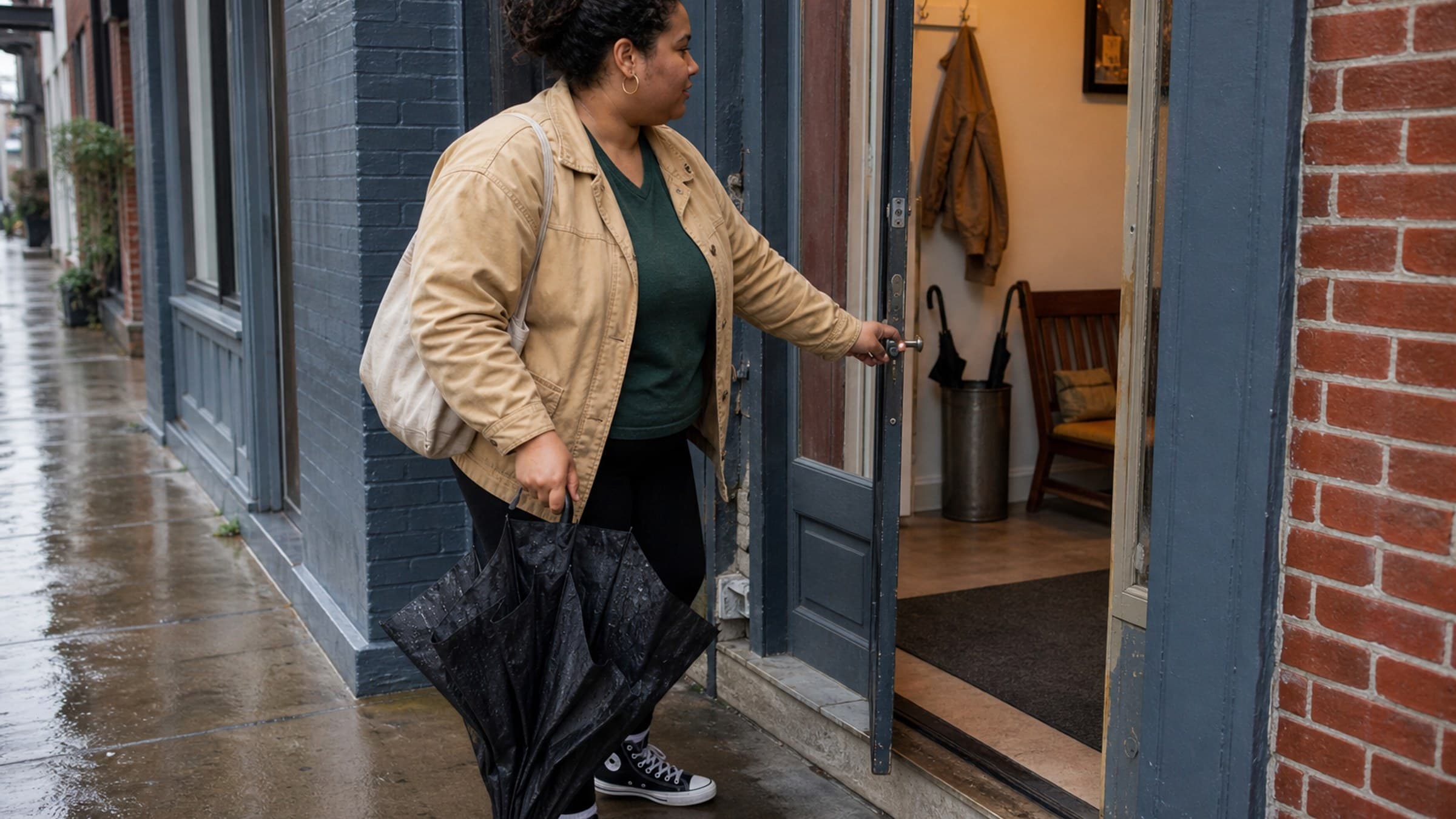
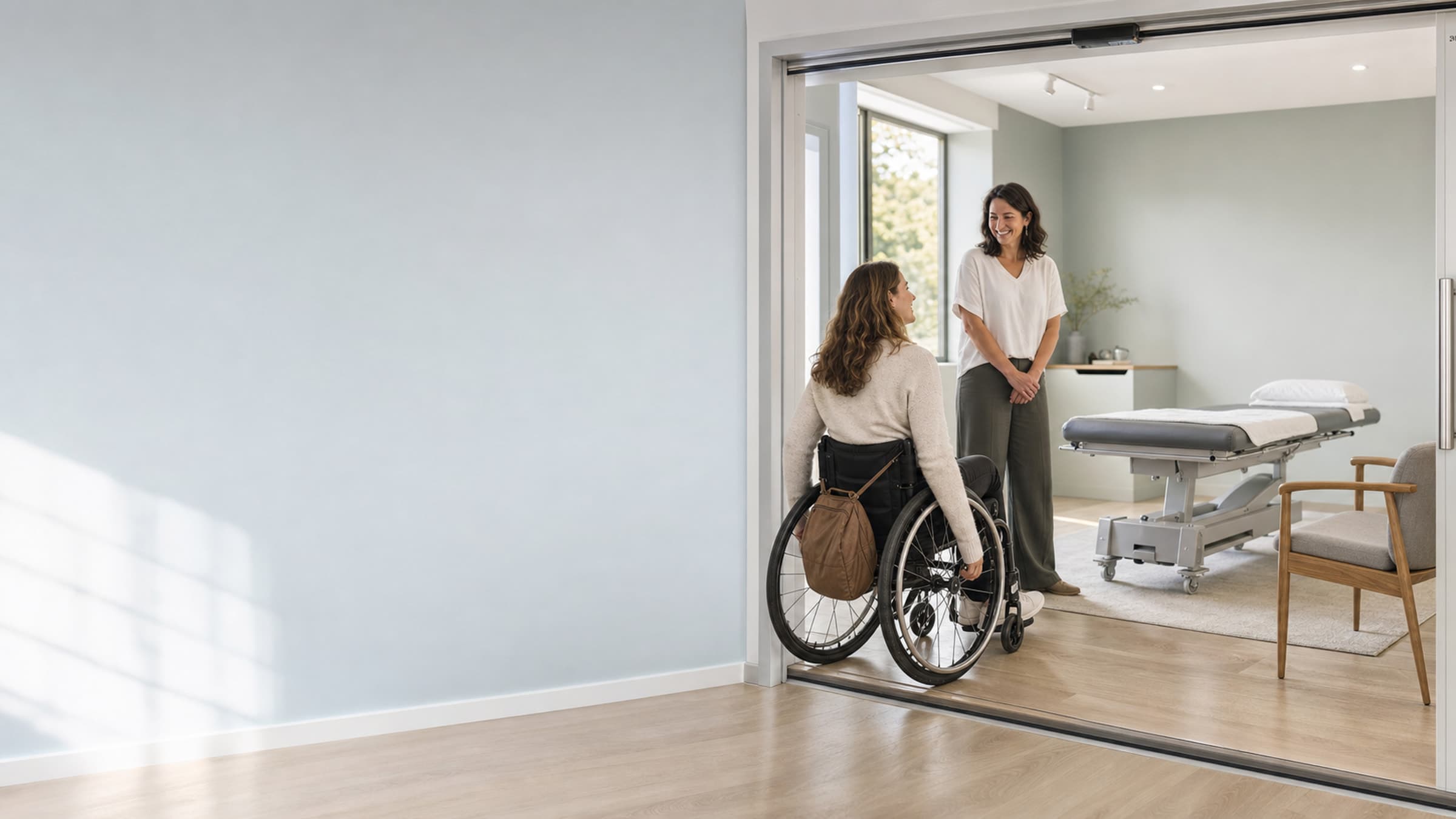
Entrance and navigation. Can someone in a wheelchair, using a walker, or with limited mobility enter your building and reach your treatment room without assistance? Look for steps without ramp alternatives, heavy doors without automatic openers, narrow hallways, and inaccessible restrooms. If you rent your space, discuss modifications with your landlord — many accessibility improvements are required under the ADA and benefit all tenants.
Treatment room setup. Consider whether your treatment table or chair is height-adjustable for clients who have difficulty getting on and off elevated surfaces. Ensure there is enough clear floor space for a wheelchair to turn around. If your modality allows it, offer the option to perform treatments with the client seated in their own wheelchair or mobility device.
Sensory environment. Strong scents, bright or flickering lights, and loud background music can be barriers for clients with migraines, chemical sensitivities, sensory processing differences, or autism. Offer a fragrance-reduced option and let clients know in advance what to expect in your space. Adjustable lighting and the ability to turn off background music are simple accommodations that make a significant difference.
Wayfinding. Clear signage with high-contrast text and large font benefits everyone, especially clients with low vision. If your practice is inside a larger building, provide specific directions (including landmarks) in your appointment confirmation rather than assuming clients will find their way.
Make your online presence accessible
Your website and online booking system are often the first point of contact with potential clients. If they are not accessible, you lose people before they ever walk through your door.
Website accessibility basics. Ensure your website works with screen readers by using proper heading structure, alt text on images, and descriptive link text (not "click here"). Use sufficient color contrast between text and backgrounds. Make sure all functionality is available via keyboard navigation, not just mouse clicks. These are not just best practices — they are legal requirements under the ADA for many businesses.
Booking flow. Test your online booking process from the perspective of someone using assistive technology. Can a screen reader user navigate the calendar, select a time, and complete the booking? Are form fields properly labeled? Are error messages clear and specific? If your booking platform does not meet these standards, raise it with the provider or consider switching.
Content clarity. Write in plain, straightforward language. Avoid jargon that assumes familiarity with your modality. A potential client who has never tried acupuncture should be able to understand exactly what to expect from reading your service descriptions. Explain what happens during a session, what to wear, how long it takes, and what the space looks like.
Multiple contact methods. Offer more than one way to book or ask questions. Some people are comfortable booking online. Others need to call. Some prefer email or a contact form. A client with phone anxiety or a speech disability should be able to engage with your practice just as easily as anyone else.
Rethink your intake forms
Intake forms are a rich opportunity to demonstrate inclusivity — or to inadvertently alienate someone before their first session.
Gender and identity. Provide options beyond a male/female binary. Include a write-in option for gender identity and a field for preferred name and pronouns. Use these consistently in all communications. This is not a political statement; it is basic respect that helps clients feel safe and seen.
Medical history with sensitivity. Frame health questions in a way that does not assume a particular body type, ability level, or lifestyle. Instead of "Do you exercise regularly?" try "What types of physical activity, if any, are part of your routine?" Instead of assuming ambulatory status, ask about mobility in an open-ended way.
Accessibility needs question. Include a simple, open-ended question like "Is there anything we can do to make your visit more comfortable?" This gives clients permission to advocate for themselves without having to bring up accommodations unprompted, which many people find awkward or stressful.
Digital accessibility of the form itself. If your intake form is a PDF that clients need to print, fill out by hand, and bring in, you are creating a barrier for people with visual impairments, motor difficulties, or limited access to a printer. Digital intake forms that can be completed on any device are more accessible and more convenient for everyone.
Language accessibility. If you serve a community with significant non-English-speaking populations, consider offering intake forms in other languages. Even if you cannot provide the entire session in another language, having forms available reduces a major barrier to entry.
Pricing and financial accessibility
Cost is the single biggest barrier to wellness care for many people. You do not need to work for free, but there are practical ways to make your services financially accessible without undervaluing your work.
Sliding scale. A sliding scale allows clients to pay what they can within a defined range. You set a full rate at the top, a minimum rate at the bottom, and let clients self-select. Be clear about who the sliding scale is for and how to access it. Some practitioners ask clients to fill out a brief income-based form; others trust clients to choose honestly. The simpler the process, the more people will use it.
Community sessions or clinic days. Dedicate a few hours per month to reduced-rate group sessions or community clinic-style appointments. Acupuncture practices have pioneered this model with community acupuncture, where multiple clients receive treatment in a shared space at a fraction of the individual session cost. This model works for many modalities.
Package and membership options. Packages and memberships that reduce the per-session cost make ongoing care more attainable. A client who cannot afford $120 per session might be able to manage $89 per month for consistent care.
Transparent pricing. List your prices on your website. Clients who are price-sensitive often will not call to ask — they will just move on. Transparent pricing removes the anxiety of the unknown and helps people self-select before the first visit.
Superbills and insurance. If your modality qualifies for insurance reimbursement, provide superbills so clients can submit for out-of-network benefits. Many clients do not realize they can get partial reimbursement. Offering this proactively makes your services more affordable without reducing your rates.
Cultural sensitivity and creating a welcoming environment
Accessibility is not only about physical space and pricing. It is about whether someone from any background can walk into your practice and feel genuinely welcome.
Examine your assumptions. Consider who is represented in your marketing materials, the art on your walls, and the magazines in your waiting room. If every image in your space reflects a single demographic, clients from other backgrounds may feel like your practice is not for them, even if that is not your intention.
Language matters. Avoid culturally appropriative language or imagery that borrows from traditions without understanding or respecting them. If your modality has roots in a specific cultural tradition, learn about and honor that history. Use person-first or identity-first language according to the preference of the community you are referring to — when in doubt, ask.
Continuing education. Seek out training in cultural competency, health equity, anti-racism, and trauma-informed care. These are not one-time workshops but ongoing areas of growth. Understanding how systemic factors affect health and healthcare access makes you a better practitioner for every client.
Feedback loops. Create a way for clients to provide honest feedback about their experience, especially regarding accessibility and inclusion. An anonymous post-visit survey, a suggestion box, or simply asking "Is there anything we could do differently to make this space more comfortable for you?" signals that you are open to learning and improving.
Neurodivergent-friendly practices
A growing number of clients are neurodivergent — autistic, ADHD, dyslexic, or otherwise neurologically different — and many have had negative experiences in healthcare settings that were not designed with their needs in mind.
Reduce uncertainty. Provide detailed information about what a session involves before the client arrives. What will the space look like? Will there be physical contact? How long will each part of the session take? What should they do if they need a break? Uncertainty is a major source of anxiety for many neurodivergent people, and detailed preparation significantly reduces it.
Offer sensory accommodations. Allow clients to wear sunglasses, earplugs, or headphones during treatment if it helps them feel comfortable. Avoid sudden changes in lighting, temperature, or sound. Ask about sensory preferences and honor them without judgment.
Flexible communication. Some clients process information better in writing than verbally. Offer to send session summaries and instructions via message rather than only discussing them in person. Be patient with clients who need more time to process questions or who communicate differently than you are used to.
Respect stimming and coping mechanisms. If a client fidgets, rocks, uses a fidget tool, or avoids eye contact, do not draw attention to it or interpret it as discomfort with your care. These are self-regulation strategies, not problems to be solved.
Progress over perfection
No practice will be perfectly accessible overnight. The goal is not to check every box immediately — it is to adopt an ongoing mindset of noticing barriers and working to remove them.
Start with one area. Audit your physical space this week. Review your intake forms next week. Look at your website accessibility the week after. Ask a trusted colleague or client from an underrepresented community to give you honest feedback about their experience in your practice.
Every barrier you remove is one more person who can access the care they need. That is what this work is about — not perfection, but a genuine commitment to making your practice a place where everyone belongs.