
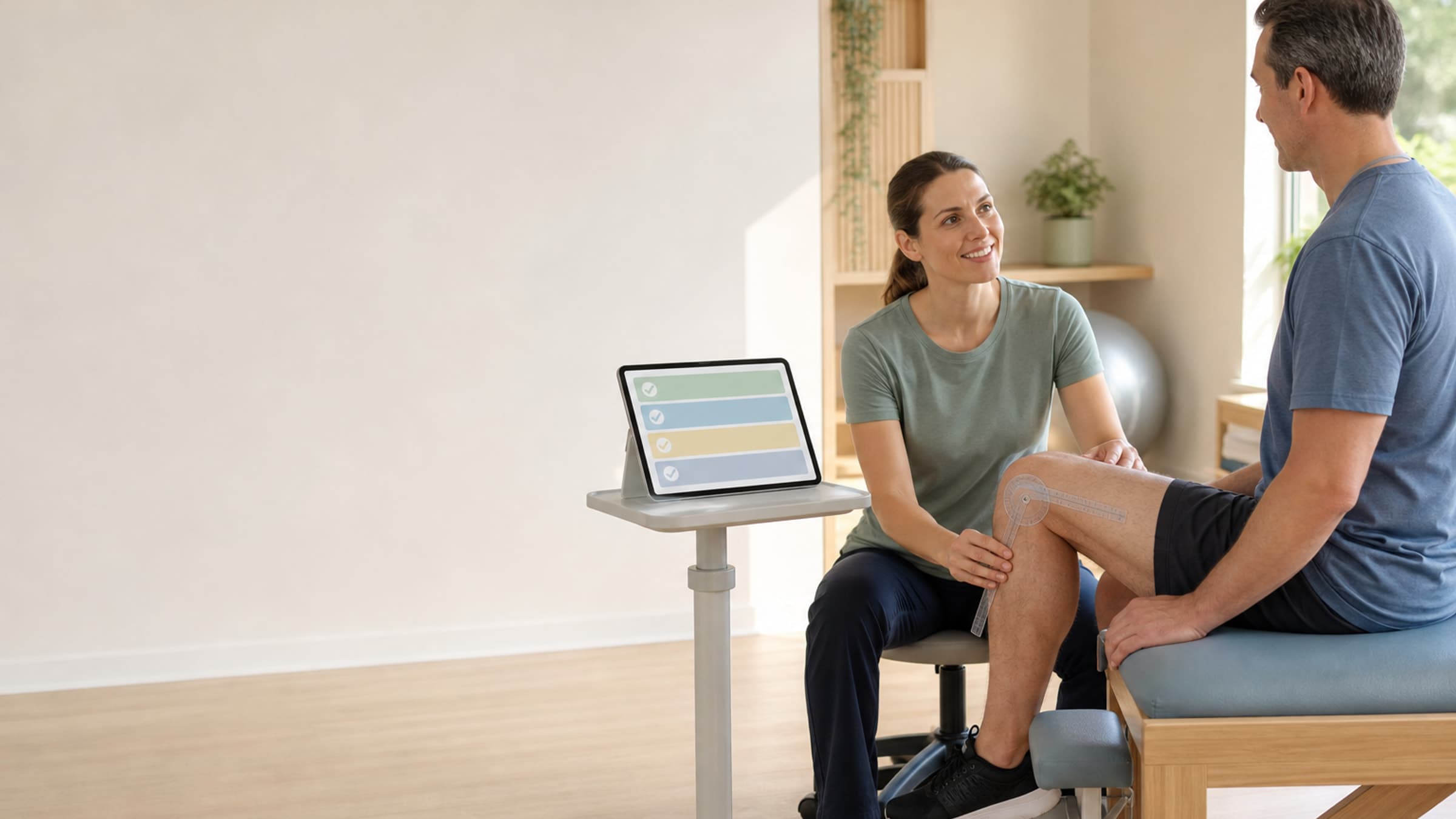
Subjective: what the patient reports
The subjective section captures the patient's perspective in their own words. For physiotherapy, this means more than just a pain rating. You want to know how the condition is affecting their function since the last visit.
Start with changes in symptoms: better, worse, or the same. Then get specific. Did they complete their home exercise program? How did they respond to the last treatment? Are there new symptoms or functional changes? If the patient says they can now walk the dog without stopping, that is a meaningful data point worth recording.
A useful framework for the subjective section: current symptom status, functional changes since last visit, home exercise compliance, and any new concerns. Keeping this structure consistent across notes makes them faster to write and easier to review.
Avoid the trap of documenting a full re-interview at every visit. The subjective section should capture what has changed, not repeat the entire history. Your initial evaluation already has the baseline. Follow-up notes build on it.
Objective: what you measure and observe
The objective section is where physiotherapy SOAP notes differ most from other disciplines. You are documenting specific, measurable findings that track progress over time. Vague observations do not cut it here.
Record range of motion with goniometric measurements. Document strength using manual muscle testing grades. Note functional test results like the Timed Up and Go, single-leg stance time, or whatever standardized measures are relevant to the patient's condition. If you performed special tests, document the test name and result, not just "positive McMurray's" but the specific findings and clinical relevance.
For treatment documentation, be precise about what you did. "Manual therapy to lumbar spine" is insufficient. "Grade IV posterior-anterior mobilizations to L4-5, three sets of 30 seconds" tells an auditor or another treating clinician exactly what happened.
Include the patient's response to treatment within the session. Did pain decrease after mobilization? Did range of motion improve after soft tissue work? These immediate responses support your clinical reasoning and justify continued treatment.
Assessment: your clinical reasoning
The assessment section is where many physiotherapists fall short, and it is arguably the most important part of the note. This is not a restatement of findings. It is your professional interpretation of what those findings mean.
Address three things in every assessment. First, is the patient progressing toward their goals? Use objective data to support your answer. "Knee flexion ROM improved from 95 degrees to 115 degrees over four visits" is far stronger than "patient is improving."
Second, explain your clinical reasoning. Why are you continuing with the current approach, or why are you changing it? If you are shifting from manual therapy to exercise-based rehabilitation, the assessment should explain the rationale.
Third, address medical necessity. Insurers and auditors look at the assessment to determine whether ongoing treatment is justified. Document specific functional limitations that remain and explain how continued physiotherapy will address them. "Patient is unable to return to work as a warehouse associate due to inability to lift more than 10 pounds overhead; current capacity is 15 pounds below job requirements" makes a compelling case.
Plan: clear, specific, time-bound
The plan section outlines what happens next. Include treatment frequency, specific interventions you intend to use, any modifications to the home exercise program, and your timeline for reassessment. For more on managing follow-up scheduling, see our guide to appointment management.
Be specific about visit frequency and duration: "Two sessions per week for three weeks, then reassess" is actionable. "Continue physiotherapy as needed" is not. If you are planning to progress exercises, note the criteria for progression. If you are considering discharge, outline what the patient needs to achieve first.
Document any referrals, conversations with other providers, or patient education you delivered. If you recommended that the patient see their GP for imaging or medication review, put it in the plan.
Writing notes during the session
The most efficient approach to documentation is writing notes during the session itself. This does not mean burying your face in a laptop while the patient exercises. It means capturing key data points in real time and structuring your note around them.
Build a workflow where you record objective measurements as you take them. Jot down the patient's subjective report during your opening conversation. Document treatment parameters as you perform them. This approach takes practice, but it eliminates the need to reconstruct the session from memory after the fact.
Some physiotherapists use a brief template or checklist on a tablet that they fill in during the session, then finalize the note in the two to three minutes between patients. This hybrid approach balances thoroughness with efficiency and keeps documentation from bleeding into personal time.
Templates that accelerate documentation
Templates are the single biggest time-saver for SOAP documentation. Build templates for your most common visit types: initial evaluations, follow-up visits, re-evaluations, and discharge summaries. Each template should include the structure and prompts specific to that visit type, so you are filling in the blanks rather than composing from scratch.
A good follow-up template might include pre-populated sections for common interventions you use, with fields for parameters, sets, reps, and patient response. Your objective section template should prompt you for the specific measurements relevant to the body region you are treating.
Practice management platforms like Stillpoint support structured note templates that guide you through each section, keeping your documentation consistent and thorough without requiring you to remember every element from memory.
Audit-proof documentation
Physiotherapy is a heavily audited profession. Insurance companies, regulatory bodies, and legal proceedings all scrutinize your documentation. The standard is clear: if it is not documented, it did not happen. Ensuring your practice meets HIPAA compliance standards is essential for protecting both your patients and your business.
Audit-proof notes share several characteristics. They use specific, measurable language rather than vague descriptions. They connect objective findings to clinical reasoning. They justify the medical necessity of each visit. They demonstrate progression or explain why progress has stalled. And they are completed in a timely manner, ideally the same day as the visit.
One pattern that triggers audits is repetitive documentation where notes look identical visit after visit. If your notes read the same for three consecutive sessions, either your treatment is not progressing or your documentation does not reflect the changes you are making. Neither is a good look.
Documentation as a clinical tool
The shift worth making is to stop thinking of SOAP notes as an administrative burden and start treating them as a clinical tool. Well-written notes sharpen your reasoning, reveal patterns you might otherwise miss, and make it easier to adjust treatment when something is not working.
When your documentation system works with you instead of against you, notes become a natural extension of clinical care rather than an afterthought that keeps you at the desk.
If you are ready to streamline your physiotherapy documentation, try Stillpoint and see how structured templates and efficient workflows can give you your evenings back.