Social media is a trust tool, not a sales funnel
When a potential client finds you on social media, they are not looking for a pitch. They are looking for a feeling. Can I trust this person? Do they understand what I am going through? Will I feel comfortable in their care?
This is fundamentally different from how most marketing advice frames social media. You are not trying to convert strangers into buyers. You are trying to give people who are already considering wellness care a reason to choose you specifically.
That shift in perspective changes everything about how you approach content. Instead of asking "What will get the most engagement?" you ask "What would help someone feel confident about booking with me?" Those are very different questions, and they lead to very different content.
Pick one platform and ignore the rest
One of the fastest ways to burn out on social media is trying to be everywhere. Instagram, Facebook, TikTok, YouTube, LinkedIn, Pinterest - each platform has its own culture, format, and algorithm. Trying to maintain a presence on all of them is a full-time job, and you already have one.
Choose the platform where your ideal clients are most likely to be. For most wellness practitioners, that is Instagram or Facebook. If you work with younger clients or in fitness-adjacent fields, TikTok might make sense. If you are building referral relationships with other healthcare providers, LinkedIn could be the right fit.
The point is not which platform you choose. The point is that you choose one and give yourself permission to let the others go. A strong, consistent presence on one platform will always outperform a scattered, inconsistent presence on four.
Post less than you think you need to
There is a persistent myth that you need to post daily to stay relevant. For large brands and full-time content creators, frequency matters. For a local wellness practitioner, it does not. Not in the way you think.
Two to three posts per week is more than enough to stay visible and build trust with your local audience. What matters far more than frequency is consistency and quality. A thoughtful post that shares something genuinely useful will do more for your practice than five filler posts that exist only to keep the algorithm happy.
If two to three posts per week still feels like a lot, start with one. One post per week, every week, for three months. That is 12 pieces of content, and it is enough to establish a rhythm and start seeing what resonates.
Focus on three content pillars
Decision fatigue is a major reason practitioners abandon social media. When you sit down to create content and your options are infinite, it is hard to start. Content pillars solve this problem by giving you a simple framework to rotate through.
For a wellness practice, three pillars tend to work well. The first is education. Share something your clients frequently ask about or misunderstand. Explain a concept, bust a myth, or walk through what a typical session looks like. This positions you as knowledgeable and approachable.
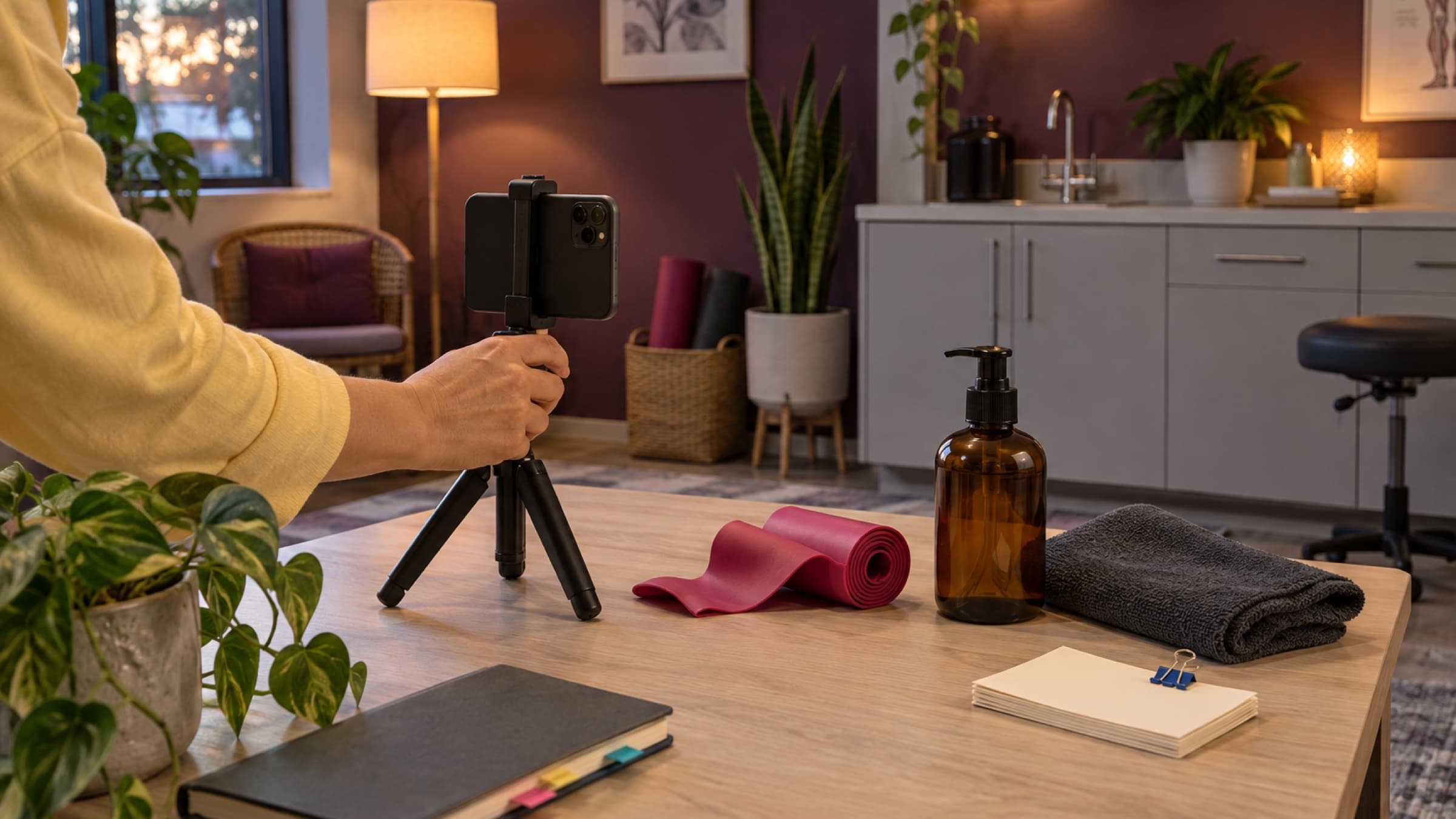
The second is behind the scenes. Show your treatment room, your morning routine, the tools you use, or a moment from your day. This is not about being polished. It is about being real. Clients want to know what it feels like to be in your space before they walk through the door.
The third is client wins, shared with permission. Talk about the kinds of transformations you see in your practice without identifying anyone. "A client came in unable to turn their head to the left. After six sessions, they are back to full range of motion." Stories like this help potential clients see themselves in your work.
Rotate through these three pillars and you will never run out of things to say.
Batch your content so it does not bleed into your day
Creating social media content in real time is exhausting. You end up thinking about what to post during sessions, scrambling for ideas at 9 PM, and feeling guilty on the days you do not post.
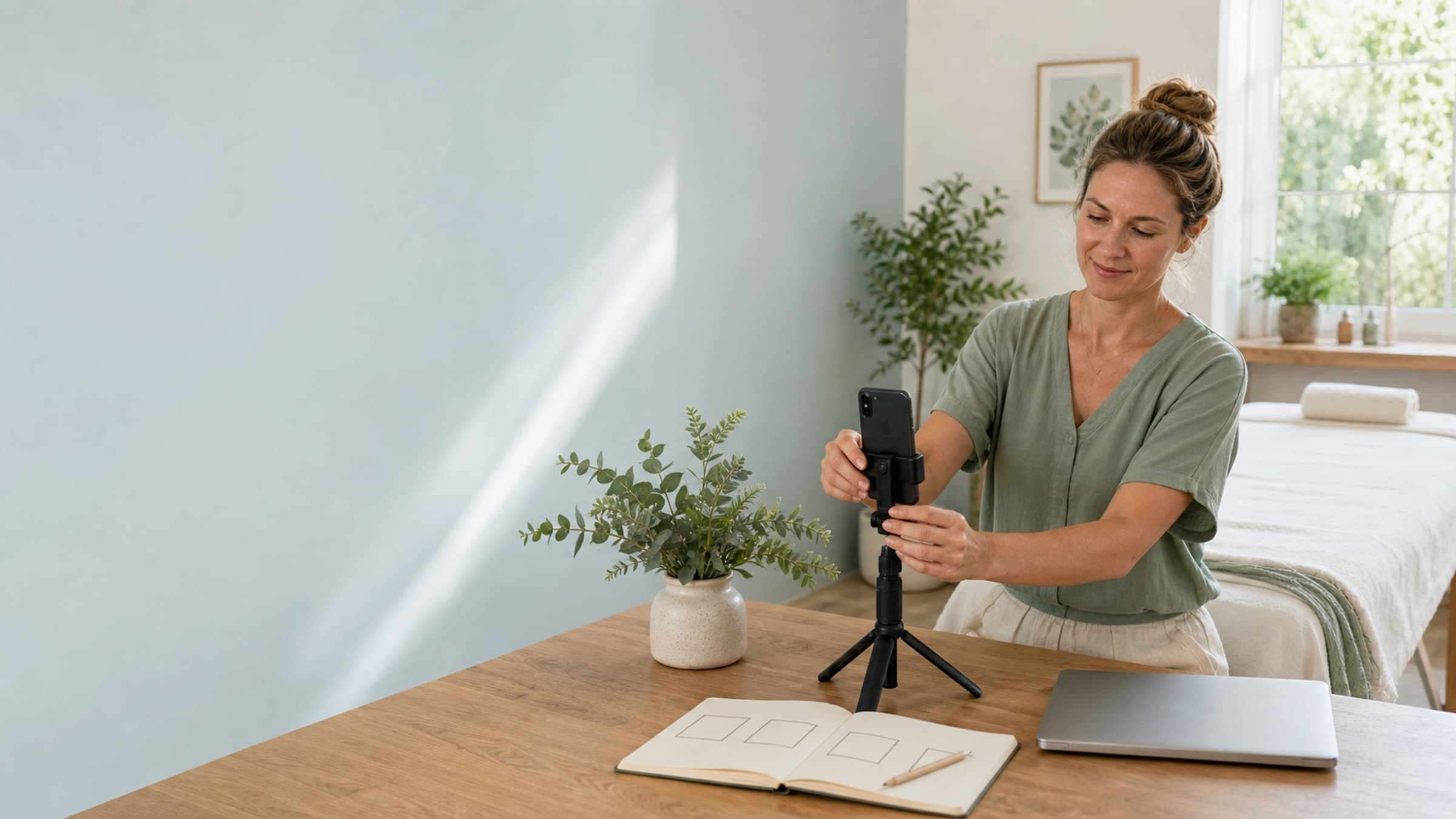
Batching solves this. Set aside one to two hours per week - or even per month, if you plan ahead - to create your content all at once. Write your captions, take your photos, and schedule everything in advance using a free tool like Meta Business Suite or Later.
When your content is scheduled, social media becomes something that runs in the background rather than something that constantly demands your attention. You can check in for engagement - replying to comments and messages - without the pressure of also needing to create something on the spot.
This one shift, from real-time creation to batched production, is often the difference between practitioners who sustain a social media presence and those who abandon it after a few weeks.
Engage selectively, not constantly
The advice to "engage with your community" is well-intentioned but often leads to hours of mindless scrolling disguised as marketing. You do not need to comment on every post in your niche or spend thirty minutes per day liking photos. That is not how local wellness clients find you.
What does matter is responding to the people who engage with your content. If someone comments on your post, reply thoughtfully. If someone sends you a direct message asking about your services, respond within 24 hours. If a fellow practitioner tags you in something relevant, acknowledge it.
Think of engagement as customer service, not networking. You are not trying to build a following. You are trying to be responsive and present for the people who have already shown interest in what you do.
Let your personality come through
The most effective wellness practitioners on social media are not the ones with the best lighting or the most professional graphics. They are the ones who sound like themselves.
If you are warm and conversational in person, write your captions that way. If you tend to be direct and no-nonsense, lean into that. If you have a dry sense of humor, let it show. The clients who resonate with your personality are the ones who will book and stay.
The temptation is to look at what other practitioners are doing and try to replicate their style. But your style is your differentiator. A potential client scrolling through a dozen practitioner profiles will remember the one that felt like a real person, not the one that looked like a template.
Know when to stop scrolling
This is the part no one talks about. Social media is designed to keep you engaged, and wellness practitioners are not immune to its pull. Comparison, self-doubt, and the feeling that everyone else is doing more - these are real occupational hazards of being on social media as a business owner.
Set boundaries for yourself the same way you set boundaries with clients. Use screen time limits. Turn off notifications. Do not check your analytics every day. And remind yourself regularly that the number of likes on a post has almost no correlation with the number of bookings it generates.
Your social media presence is one small part of a much larger picture. Referrals, word of mouth, your Google Business profile, and the experience you create in your practice all matter more. Social media is a supplement, not a substitute.
Measure what actually matters
Vanity metrics - followers, likes, reach - feel important but rarely translate directly to practice growth. The metrics that matter for a local wellness practice are much simpler.
Track how many inquiries or bookings you can trace back to social media each month. Ask new clients how they found you. Notice which posts generate direct messages or questions. Pay attention to whether your booking page gets more traffic after you post.
These signals tell you whether your social media effort is actually working, not whether it is popular. A post that reaches 200 people but leads to two new client inquiries is more valuable than a post that reaches 2,000 people and generates nothing but likes.
Give yourself permission to take a break
If social media starts to feel like a burden, it is okay to step back. Your practice will not collapse because you took two weeks off from posting. Your existing clients will not leave because your Instagram went quiet. And the clients who are meant to find you will find you through other channels like reviews and referrals in the meantime.
The most sustainable approach to social media is one you can maintain for years, not one that demands everything for a few months and then gets abandoned. If that means posting once a week instead of three times, do that. If that means taking the summer off and coming back in the fall, do that. If that means hiring someone to handle it for you eventually, that is a perfectly valid choice too.
The goal is not to master social media. The goal is to use it just enough to support the work you are already doing well - helping people feel better, one session at a time.