
The guilt showed up before the pain did
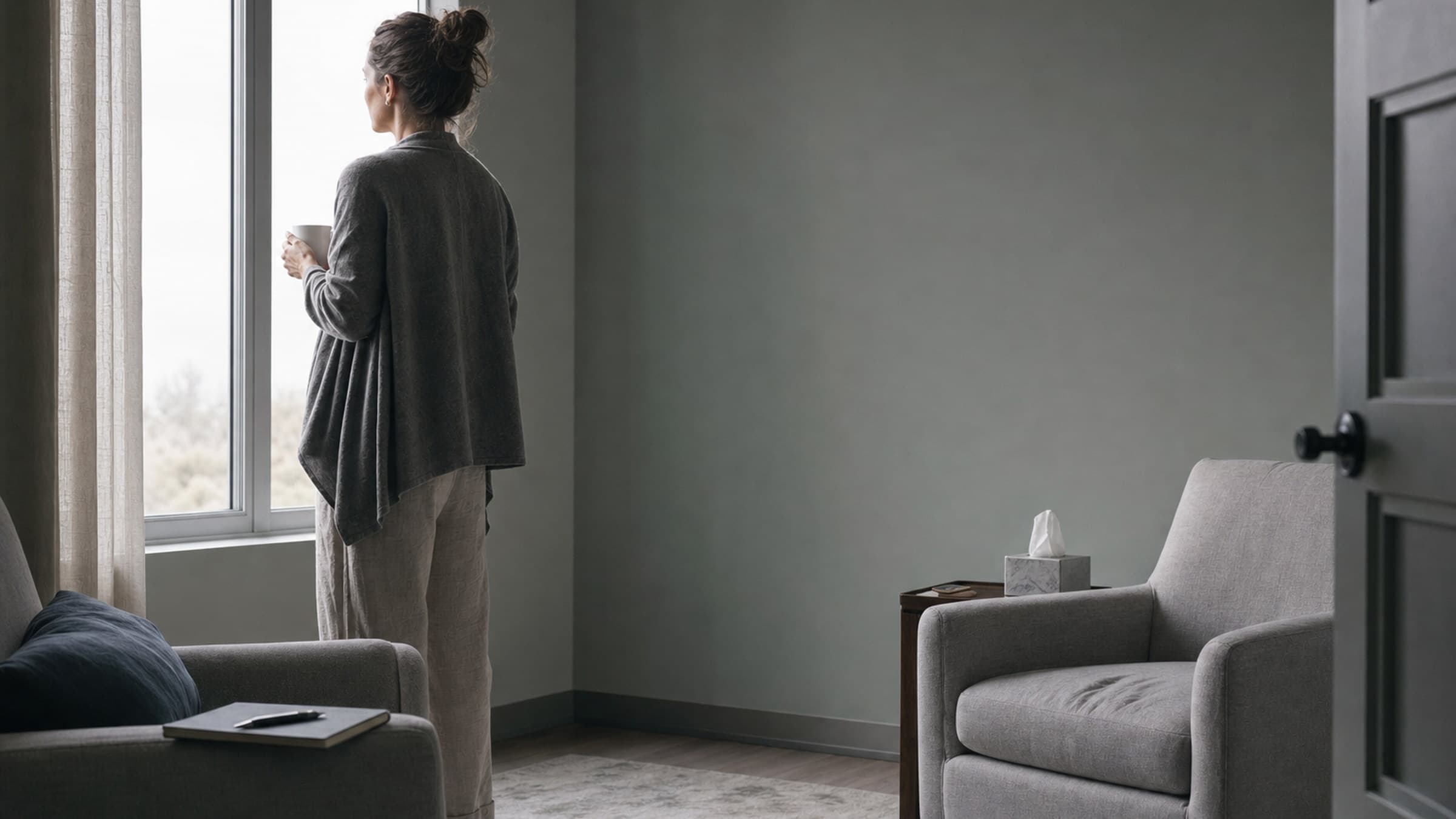
By week two, the incision was healing fine and the guilt had fully arrived. Not guilt about the surgery, I had needed it for a year and put it off twice already. Guilt about the empty room. I kept picturing my treatment chair sitting there in the quiet, unused, a small monument to income I wasn't making and clients I was letting down.
That is the part nobody warns you about. The physical recovery has a shape you can track: less pain each day, more range of motion, a follow-up appointment where someone tells you objectively how you are doing. The guilt has no such shape. It just sits there next to you regardless of how well the healing is going, whispering that a good practitioner would have found a way to keep seeing people somehow.
I want to be honest about how untrue that whisper was. There was no way to keep seeing people. My job required two working arms and the ability to stand for forty minutes without wincing. Wanting to work anyway was not dedication. It was the same old habit of measuring my worth by how full the calendar stayed, dressed up as concern for my clients.
Coming back slower than felt reasonable
When I did return, I did not go back to my old schedule. I went back to a third of it. Three clients a day instead of nine, longer breaks between each one, and a hard stop by early afternoon whether my body felt ready to keep going or not. On paper this looked cautious to the point of overcorrection. In practice it was still exhausting. Nobody tells you that healed tissue gets tired faster than tired tissue, that the arm doing normal work again for the first time in two months will ache in ways that have nothing to do with anything going wrong.
The hardest part was not the fatigue. It was the questions. More than one client asked, gently but directly, whether I was sure I was ready. A few asked it because they were genuinely worried about me. One asked it, I think, because she was worried about herself, about whether a practitioner still healing could give her the same session she was used to. I did not have a script for that question the first few times it came up, so I mostly just told the truth. Yes, my surgeon cleared me for this specific kind of work. Yes, I would tell you if a technique was off the table for now. No, I was not going to push past what my body could actually do today just to prove a point.
Saying that out loud, calmly, more than once, did something I did not expect. It made the return easier, not harder. Clients did not need me to perform full recovery. They needed to know I was paying attention to my own limits, because a practitioner who ignores her own body is not exactly a reassuring model for someone trying to learn to listen to theirs.
What the phased return actually taught me
I had assumed, going in, that the lesson of all this would be about rest. It was not, not really. The lesson was about pacing a practice to a body instead of to a spreadsheet. Before the surgery, my schedule had been built around a number, how many sessions I needed to hit a certain income, and I had simply assumed my body would keep up with whatever number I picked. It mostly had, for years, right up until it very much did not.
The slow return forced me to build the schedule the other way around. What can this arm actually do this week, this month? What does a sustainable day look like if I am not allowed to grit my teeth through the last two appointments? Some of those answers were temporary, tied to healing. But some of them stuck around even once I was fully cleared, because it turned out a slightly lighter day was not just what my recovering body needed. It was what my body had needed for a while, quietly, before I gave it a reason serious enough to listen to.
Nine months out now, I see one or two more clients a day than I did right after the surgery, and noticeably fewer than I did before it. The income evened out. The waitlist came back. What did not come back, and I am glad it didn't, was the assumption that a full body is an infinite resource you can schedule against without consequence.
The chair was still there when I got back. So was the practice, mostly intact, patient in a way I had not expected it to be. If you are staring down a recovery right now and trying to calculate how fast you can get back to normal, I would ask a different question instead: what would it look like to build the schedule around the body you actually have this season, rather than the one you are hoping comes back on your timeline?