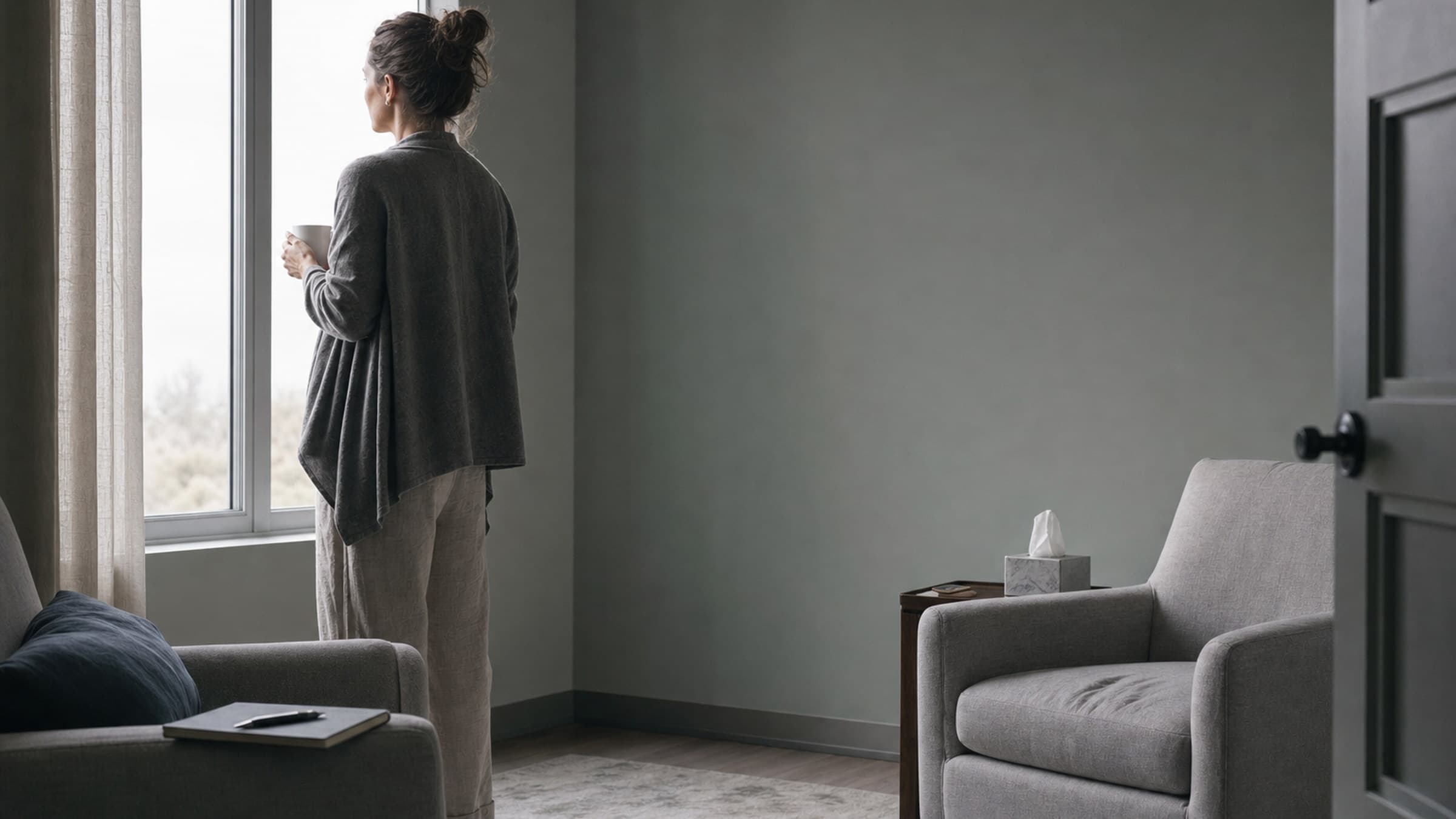

The client who comes home with you
Ask any experienced practitioner and they can name the type. Not the hardest client, necessarily. The one who lingers. Sometimes it is the person in genuine crisis, and the worry is appropriate and human. But just as often it is the quieter one: the client you could not quite reach, the session that felt off, the moment you replay wondering if you should have said the other thing.
That replaying is not weakness. It is the mind trying to finish an interaction that does not have a clean ending. The problem is that it happens on your time, in your kitchen, during your own life. And unlike a colleague in a clinic, the solo practitioner often has no one in the next room to say the sentence that ends it: yes, you handled that fine, let it go.
The absence of that voice is one of the least discussed costs of working alone. Not the loneliness of an empty waiting room. The loneliness of carrying every judgment call by yourself.
Why it hits harder than it used to
New practitioners often assume the weight will lighten with experience. In some ways it does. You get better at pacing, at boundaries inside the session, at not taking the bait when someone is testing you. But two things quietly work against you.
The first is volume. Early on you have a handful of clients and a great deal of energy per client. A full practice means the same finite reserve is spread across many more people, more stories, more standing worry. The math is not in your favor, and no amount of skill fully cancels it.
The second is that a full practice tends to crowd out recovery. The buffer you used to have between sessions gets sold to a paying client. The admin that used to happen during the day gets pushed to the evening. The walk you took to clear your head becomes a thing you will do again once the quarter calms down. It never quite calms down. So the residue has nowhere to go but home.
The difference between caring and carrying
Here is the distinction that changes things for a lot of practitioners. Caring is what makes you good at this. Carrying is what burns you out. They feel similar from the inside, which is exactly why they are easy to confuse.
Caring is fully present attention during the hour. Carrying is rehearsing the hour at 11pm. Caring is holding a client's difficulty while they are in front of you. Carrying is holding it while you are trying to fall asleep. The goal is not to care less. It is to notice when caring has quietly turned into carrying, and to have a way to hand the weight back to where it belongs, which is the room, not your body.
Small ways practitioners set it down
None of these are cures. They are the unglamorous habits that let people do this work for decades instead of a few intense years.
A closing ritual, however small. Writing the note before you leave rather than at home. Wiping down the room. A specific song on the drive that means the day is done. The brain responds to consistent cues, and a ritual is a way of telling yourself the shift is over.
A named person to debrief with. A peer, a consultation group, a supervisor you actually call. The point is not advice. The point is another human saying the sentence that closes the loop your own mind will not.
A boundary you keep even when it feels selfish. No client notes after a certain hour. Phone out of the bedroom. The number of clients per day that you know, from experience, is your real ceiling and not the one your calendar could technically hold.
And permission to be affected. The practitioners who last are not the ones who feel nothing. They are the ones who let themselves feel it, name it, and then put it down, rather than pretending the residue is not there until it becomes something larger.
The part worth remembering
If you go home carrying the day, it is not a sign you are doing the work wrong. It is a sign you are doing work that matters, with a real person, using yourself as the tool. The task is not to stop caring. It is to build a practice, and a life, that gives the caring somewhere to land at the end of the day so it does not all land on you.
What would it take for the last client of your day to actually be the last thing you carry?