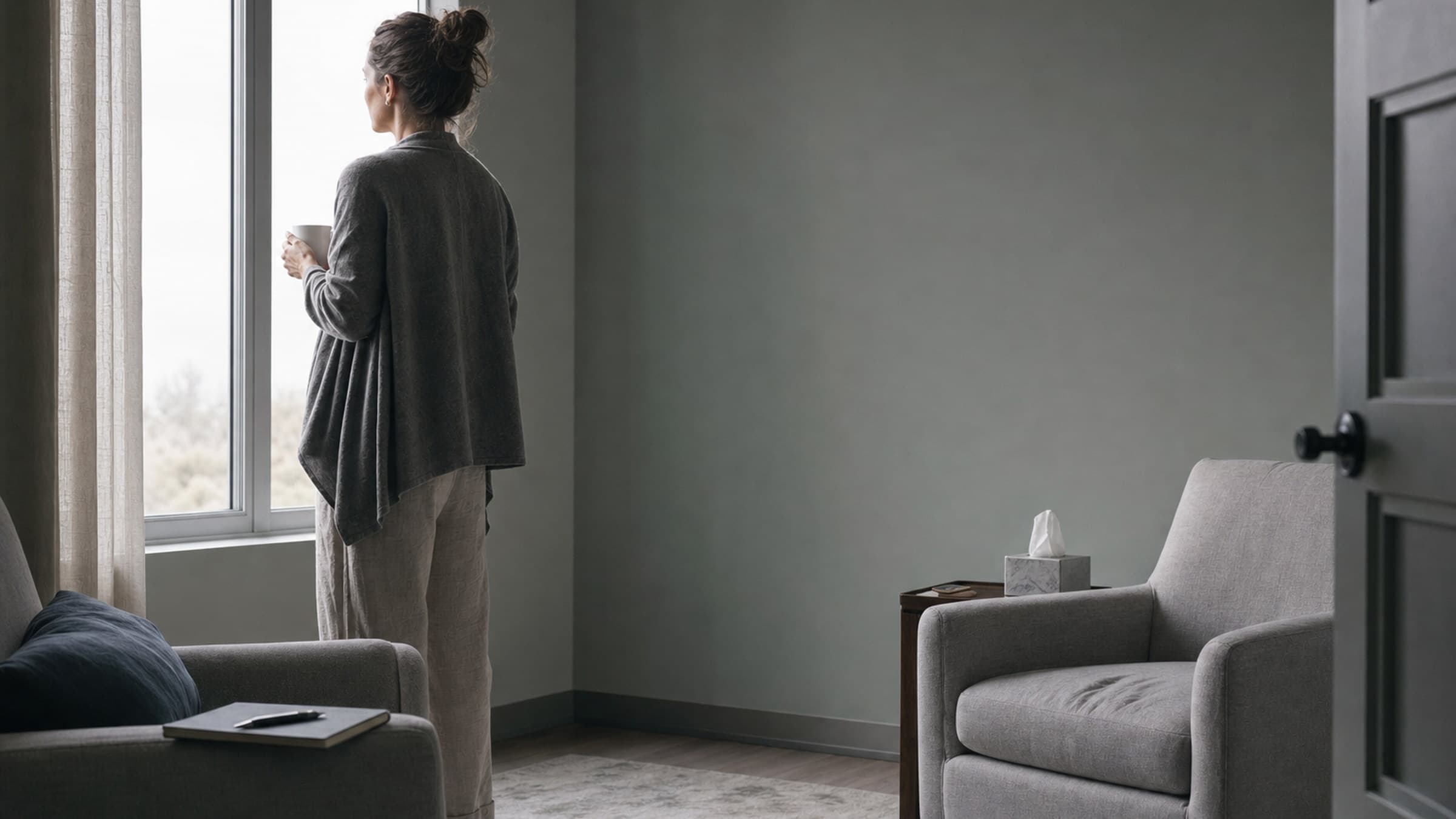

The double shift no one sees
Here is what the calendar showed that year: a healthy practice. Full most weeks. A waitlist, even. From the outside it looked like everything was working.
Here is what the calendar did not show. The 6 a.m. calls to the facility before my first client. The lunch breaks spent on hold with a pharmacy. The Tuesday I drove ninety minutes each way to sit with him through a doctor's appointment, then drove back and saw a full afternoon of clients as if nothing in my own life had shifted under me. The nights I did his paperwork after I finished my own notes, two stacks of forms on the same kitchen table, one about strangers I was helping and one about the man who taught me to ride a bike.
Caregiving is a second job that arrives without an offer letter. Nobody hires you. Nobody trains you. You just wake up one ordinary week and realize you are now responsible for another person's medications, meals, moods, and dignity, on top of everything you were already responsible for. And if your first job is emotional labor, the two do not politely take turns. They stack.
I kept expecting to feel it in the sessions. I braced for the day I would go blank in front of a client, or catch myself checking the clock, or feel the empathy run dry. Strangely, that day did not come the way I feared. The sessions were often the easiest part of the week, because in that room the role was clear and the boundaries were built in. It was everything around the sessions that frayed.
What I got wrong for months
For a long time my plan was simply to absorb it. To be the professional who does not let her personal life touch her work. I thought that was integrity. I thought clients deserved a practitioner whose own life never intruded, so I built a wall and carried the whole weight on my side of it.
The wall was not the problem. Clients genuinely do not need to manage my life, and the containment that lets someone bring their hardest material into a room is real and worth protecting. The problem was that I had confused two very different things. I had decided that keeping my father out of the therapy room also meant I was not allowed to change anything about how I worked. As if honoring the boundary required me to pretend my capacity had not changed at all.
It had changed. Of course it had. A person doing two full-time roles has less to give than a person doing one, and no amount of professionalism rewrites that math. I was running a full caseload built for the life I used to have, and quietly falling apart in the gaps.
The week I let the schedule breathe
The shift, when it finally came, was almost boringly practical. I did not have a breakthrough. I did not journal my way to insight. I just looked at my week and asked a question I had been avoiding for months: what would this look like if I built it for the life I actually have right now?
So I made it lighter. I moved from eight sessions some days to five. I put a real gap after lunch, not a fifteen-minute buffer but an hour, so that a call from the facility did not detonate my whole afternoon. I stopped booking new clients into the slots I knew I would need for his appointments. I told my two longest-standing clients, in the plainest possible way, that I was reducing my hours for family reasons and that their care would not change. Neither of them blinked. One of them said, "Good. You look tired." That was all. The thing I had feared would unravel my practice barely registered as news.
Reducing the caseload did not cost me the practice. It saved it. A smaller number of sessions I could actually be present for was worth more, to my clients and to me, than a full book I was white-knuckling through. The waitlist did not vanish. The income dipped, and I had planned for that dip and it was survivable. And for the first time in months I was not stealing from my father to pay my clients, or from my clients to pay my father, or from my own sleep to cover both.
What that year left me with
He died the following spring. I took two weeks, then came back slowly, and that is a different story with its own quiet.
What stayed with me was smaller and more useful than grief. I learned that a practice is not a fixed object you either keep intact or lose. It is a living arrangement that is allowed to change shape when your life changes shape. Reducing your hours during a hard season is not a failure of commitment. It is commitment, applied honestly to the truth of what you can carry.
I learned that clients are far more capable of hearing "I am reducing my hours" than we give them credit for. The people who trust you with their inner lives are not fragile. They are, more often than not, relieved to see you model the exact boundary you keep encouraging them to set.
And I learned that the phone face-up on the desk was never really about emergencies. It was about the belief that being a good daughter and a good practitioner both required me to be endlessly, invisibly available. Neither of them did. Both of them were better served by a person who let herself be a person.
If you are in a hard season right now, running a full book while carrying something heavy at home, here is the question I wish someone had asked me sooner: what would your schedule look like if you built it for the life you actually have this month, instead of the one you had before everything changed?