
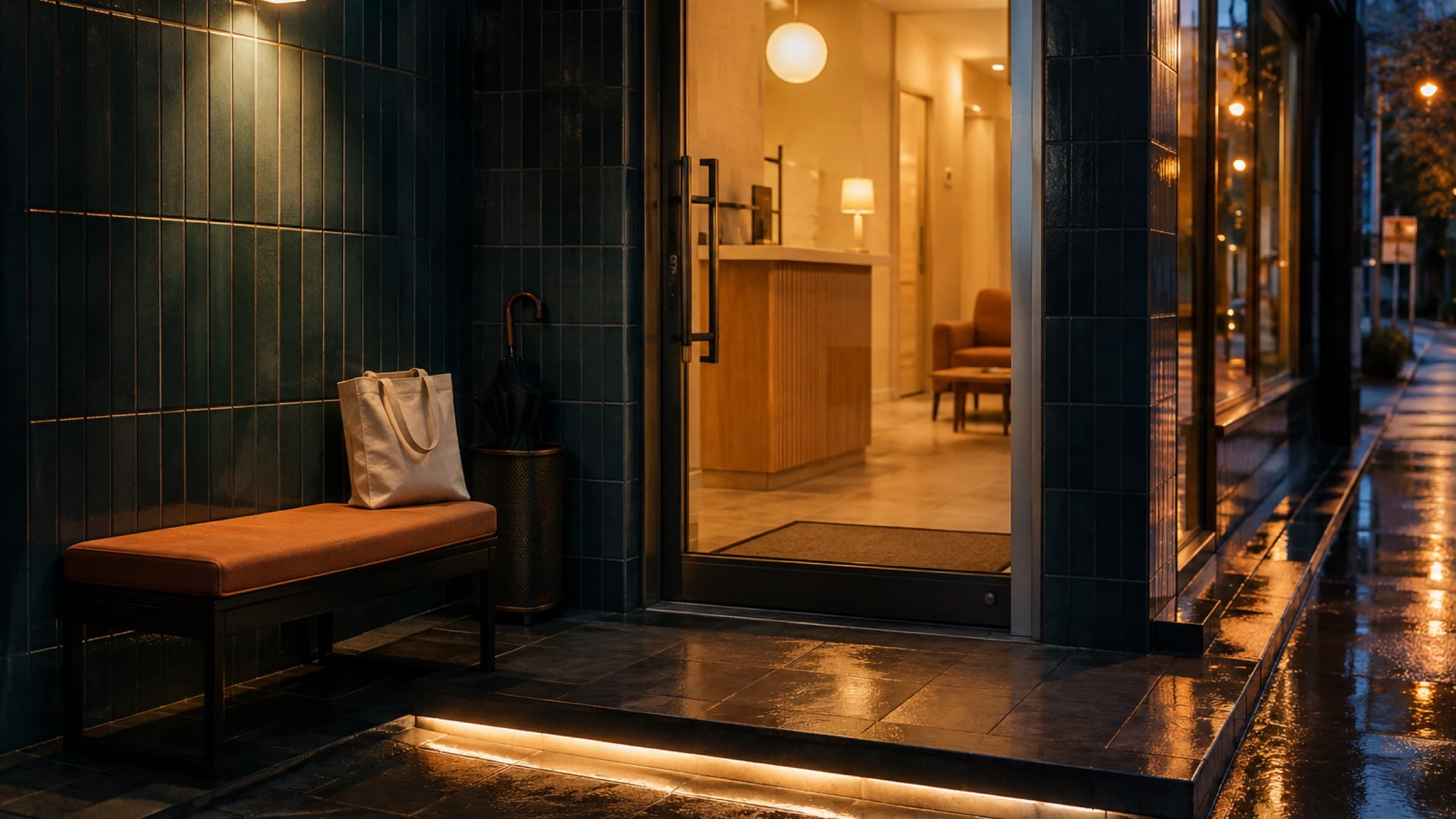
Walk the route at the right time
Do not assess evening arrival at noon.
Choose a time close to your last appointment of the day. Start where a client is likely to arrive, whether that is the sidewalk, parking area, transit stop, elevator, or shared lobby. Put your phone away and follow the route without relying on what you already know.
Notice the first moment you can confidently identify the practice. Then notice every decision that follows:
- where to turn from the street or parking area;
- which entrance to use;
- whether a step, curb, or change in surface is easy to see;
- where to find the buzzer, keypad, or door handle;
- which way to go inside the building; and
- where a client should stop and wait.
If another person works with you, ask them to walk separately. They may notice a reflection, dark corner, or confusing doorway that your own routine has trained you to ignore.
Look for guidance, not maximum brightness
More light is not always better. A very bright fixture can create glare, flatten a building number, or make the area beyond it seem darker.
What clients need is a readable path. The entrance should be easier to recognize than the doors around it. Changes in level should be visible. A person should be able to move from outside to reception without crossing a patch where they cannot see the floor or what comes next.
Stand at each decision point and look ahead. Can you see the next place you need to reach? If the answer is no, identify the smallest useful cue. It may be a working wall light, a lamp visible through the entry, a brighter bulb in a shared hallway, or a clearer instruction sent before the appointment.
Avoid turning the route into a runway of harsh light. The goal is confidence, not intensity.
Check transitions for glare and shadow
Your eyes need a moment to adjust when you move between bright and dark spaces.
That matters at glass doors, covered entrances, stairwells, and reception areas. A bright lobby reflected in a dark window can hide the handle or make the glass look like a mirror. A warm treatment room beside an unlit hall can leave the threshold hard to read. A lamp placed behind the reception desk can light the room while leaving the client's side of the counter in shadow.
During the walk, pause before every transition. Look from outside in, then turn around and look from inside out. Check the route at standing height and from a seated position in the waiting area. If the entrance has glass, make sure the edge and opening direction are easy to understand without relying on a tiny label.
You are not trying to design perfect lighting. You are looking for places where the next movement is unclear.
Make the waiting point feel intentional
An evening client may arrive when the reception desk is empty or the previous appointment is still finishing. The place where they wait should look like a place they are allowed to be.
Sit there for two minutes. Can you see enough to put away a coat, read a short message, and notice when someone approaches? Does the seating face a dark doorway or a bright bare bulb? Can the client accidentally see into a treatment room, staff area, or computer screen when a door opens?
A shaded lamp, a repositioned chair, or a closed interior door can improve both comfort and privacy. Keep the space simple and cared for. One useful light and a clear place to sit usually feel more welcoming than several decorative fixtures that do not illuminate the path.
If there is no indoor waiting area, make that clear before the client arrives. Good lighting cannot fix an expectation that was never explained.
Fix the small failures first
Write down every issue, then sort the list by how often a client encounters it and how easily it can be fixed.
Start with ordinary failures:
- replace a dead or mismatched bulb;
- clean a fixture or glass panel that has become cloudy;
- move a lamp so it lights the route instead of shining into someone's eyes;
- reset a timer that still follows summer daylight;
- ask the building manager about a dark shared stair or exterior path; and
- remove an object that casts an unexpected shadow across a step.
Test each change from the client's starting point. A light can appear fixed from inside while still leaving the entrance difficult to find from the street.
For electrical work, damaged fixtures, or changes to shared building lighting, use the appropriate qualified person or property contact. The lighting walk is a way to notice problems, not a reason to repair something outside your scope.
Update the message when the building cannot change
Some lighting is not yours to control. You may rent one room in a larger building, share an entrance, or work somewhere with exterior fixtures managed by a landlord.
When a physical fix will take time, give the client one precise sentence that helps them through the uncertain point:
For evening appointments, use the blue courtyard door. The building number is above the light on your left.
Describe a stable landmark and the next action. Do not write a long apology for the building, and do not make the client solve the whole route from a paragraph.
Add the sentence to the confirmation or reminder they already receive. If the instruction is seasonal, set a date to remove or review it. Old warnings make current information harder to trust.
Repeat the walk when the season changes
One lighting check is not permanent.
Repeat it when sunset moves into your appointment hours, building access changes, construction alters the route, or clients start calling from the same spot. Check again after a fixture is replaced because a different bulb can change glare and shadows even when the area looks brighter.
You can also ask a simple question after a first evening visit: "Was the entrance easy to find in the dark?" You do not need a survey. One specific answer may show you exactly where the route stopped making sense.
Stillpoint's email templates let you add location and pre-session details to confirmation messages. Automated reminders can repeat the useful part before the appointment. A short, accurate arrival cue cannot replace a well-lit route, but it can help a client reach the right door calmly while you work through a physical fix.