
Arrive as if you have never been there
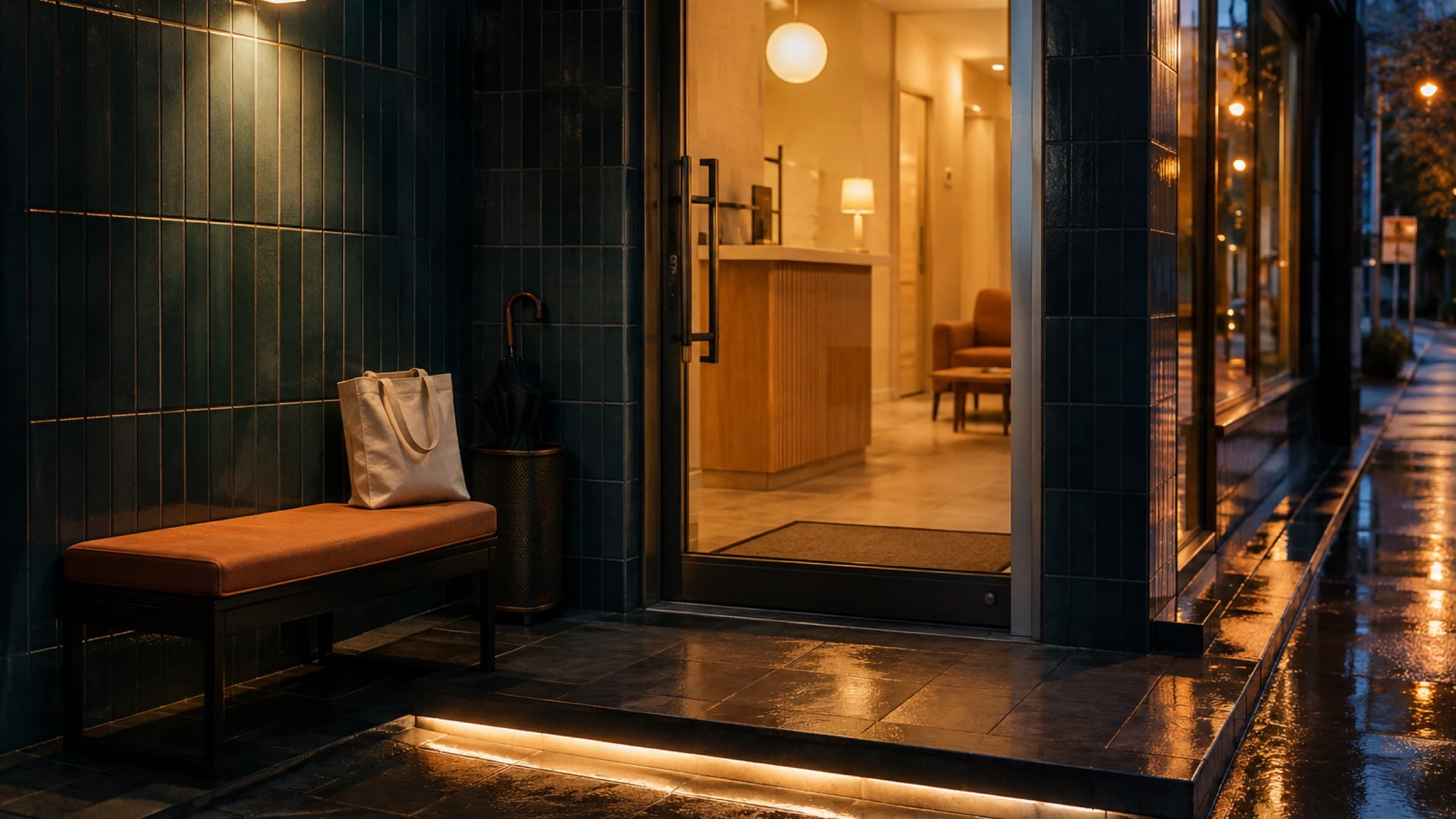
Start outside the practice. Put away your keys and take the route a client would take from the street, parking area, lift, or building entrance.
Notice the first moment when you need information. Is the correct door obvious? Can you tell whether to knock, ring, or walk in? If the practice shares a building, can you find the right floor and suite without relying on a tiny directory? If the door is locked between appointments, does the client know what to do next?
Try this in the conditions that make arrival harder. Come in when the hallway is quiet, when another business is busy, or when the weather has changed. A route that feels obvious at noon may feel uncertain on a dark morning.
Write down each decision you had to make. Do not solve anything yet. The point is to notice where your familiarity filled in a gap that a new client would have to navigate alone.
Sit in the chair a client is most likely to choose
Do not sit at the reception desk. Choose the chair nearest the door, the one facing the hallway, or the seat that gives someone the clearest view of what happens next.
Stay there for ten full minutes without doing practice work. Put your phone away. Let the room have your attention.
Look at what is directly in front of you. A tidy room can still feel confusing if there is no clear place for a coat, a wet umbrella, a mobility aid, or a bag. A beautiful chair can still be uncomfortable when someone has to wait in it. A water station can create more uncertainty than comfort if the cups are hidden or it is not clear whether clients may help themselves.
Pay attention to what your body is doing. Are you sitting in a draught? Is the chair difficult to rise from? Are your knees crowded by a low table? Is the only open seat directly under a bright light or beside a noisy fan?
These details do not need to be perfect for every person. They need to be visible enough that you can offer an alternative before someone has to explain why the obvious option does not work for them.
Listen for uncertainty, not just noise
Your waiting room has a sound pattern. There may be footsteps in the hall, a door latch, music, traffic, ventilation, or conversation from reception.
Ask two separate questions. First, can a waiting client hear private conversation from another room? Second, can they hear the cue that tells them what to do next?
A loud room can create both problems at once. Background sound may cover parts of a conversation without protecting it consistently, while also making a softly spoken name or instruction hard to catch. A very quiet room can make every phone call and closing door feel unusually exposed.
You do not need to diagnose the acoustics during this check. Notice what carries, what disappears, and whether the room changes when a door opens or the ventilation stops. If privacy is uncertain, test it properly with fictional information and another team member. Never use a real client's details for the rehearsal.
Check what the room communicates without words
Waiting rooms collect instructions even when nobody meant to create them. A chair behind a small table may look reserved. A stack of forms may suggest that every client should take one. A closed treatment-room door may make someone wonder whether they have been forgotten.
Look for signals that compete with each other:
- a welcome sign beside a locked internal door;
- a coat hook that is hard to reach or already full;
- a check-in device that looks active when it is not used;
- a water station without an obvious place for used cups; or
- several doors with no clue which one leads to a washroom.
Remove anything that looks like an instruction but is no longer true. A blank surface is often calmer than an outdated sign, an unused clipboard, or a device that invites the wrong action.
Also notice what is visible from the chair. Turn over appointment sheets, move labelled files, and change any screen that can reveal a name, time, email address, or clinical detail. Privacy problems are easier to prevent when you check from the client's sightline instead of from behind the desk.
Try the room at a real transition point
An empty waiting room at opening time is not the same room clients experience between appointments.
Repeat the ten-minute sit when one client is leaving and another is arriving. Notice where coats, shoes, bags, mobility aids, and conversations gather. Check whether the route to the treatment room becomes narrow. Listen to what a waiting person can hear during checkout or rebooking.
If you share the space with another practitioner, include the moments when both schedules turn over together. You may discover that each person's routine works well on its own and becomes confusing only when two doors open at once.
This is not a reason to make clients move through the practice in silence. A warm goodbye is part of good care. The goal is to make sure ordinary human moments do not accidentally expose private information or leave the next person unsure where to stand.
Fix the smallest points of friction first
Your notes may include expensive ideas, but the best first changes are often modest.
Move one chair out of the draught. Clear a reachable hook. Replace three signs with one accurate instruction. Put used cups where the next person can see them. Angle a monitor away from the room. Add a short line to the arrival message explaining whether the door will be open.
Choose one change that reduces uncertainty and one that improves comfort. Then sit in the room again. A useful adjustment should be easy to understand from the chair, not only sensible from the reception desk.
Keep a short list for changes that need more planning, such as a heavy door, a narrow route, poor sound separation, or inaccessible seating. Assign each item to a person and a date rather than trusting the list to stay memorable.
Repeat the check when the conditions change
Ten minutes once a year is better than never. Ten minutes when the practice changes is better still.
Repeat the check after moving furniture, adding a practitioner, changing rooms, or updating the way clients enter. Try it in another season. Coats, wet footwear, heat, darkness, and open windows can all change how the same small room works.
Invite another team member to do the check without giving them your conclusions first. They may choose a different chair, notice a different sound, or assume a different route. That difference is useful. Clients will not all read the room the same way either.
Stillpoint lets you customize appointment reminder content and add service-specific pre-session instructions. Once you know where arrival becomes uncertain, use those messages to tell clients what they need before they reach the door. Explore automated reminders and email templates.