Describe the class as it actually feels
Start with the public class description. A name such as "All Levels Movement" may sound welcoming, but it does not tell a new client what all levels means in your room.
Give them enough detail to picture the experience:
- the pace of the class;
- whether the session is standing, seated, on a mat, or a mix;
- what equipment you provide;
- what the client should bring;
- whether there are quieter or more supported options; and
- who should contact you before booking.
Avoid promising that a class is suitable for everyone. No single format can meet every need without a conversation. A more useful line is: "You will be offered options throughout the class. If you are unsure whether the format fits your needs, contact us before booking and we will help you decide."
That is welcoming without asking the client to disclose personal health information in a public booking form or general email.
Send the practical details after booking
The confirmation should answer the questions that affect whether the client arrives successfully.
Include:
- the date, start time, and expected finish time;
- the exact location and which entrance to use;
- how early to arrive for a first visit;
- what to wear or bring;
- whether equipment is provided;
- what happens if the client needs to cancel; and
- a way to ask a practical question.
Keep this message short enough to scan on a phone. Put the most important arrival instruction near the top rather than hiding it after your full policy.
For example:
Please arrive 10 minutes early for your first class. Use the side entrance beside the blue awning. We provide mats and blocks, so bring only comfortable clothing and a water bottle.
If the building is difficult to find, add one useful landmark. If the door locks when class begins, say what the client should do if they arrive late. Do not make a new person guess whether knocking will interrupt the room.
Use one reminder to reduce uncertainty
A reminder is not only there to prevent a forgotten booking. It can remove the last small uncertainty that might keep someone home.
Repeat the start time, arrival window, entrance, and one essential preparation detail. You do not need to repeat the complete class description or every studio rule.
For a morning class, the reminder might say:
We will see you tomorrow at 9:00 a.m. Please arrive by 8:50 for your first visit. Mats and blocks are ready for you, and the side entrance opens at 8:45.
Use the communication channel the client has agreed to receive. Keep sensitive health or treatment details out of a text reminder. If a client needs to discuss whether the class is appropriate for them, move that conversation into your normal private communication process.
Make the room explain itself
When a new client enters, they should be able to tell where to put their things, where the class will happen, and who is leading it.
You do not need a collection of signs. A few visible choices are usually enough:
- Keep the entrance and check-in point clear.
- Put borrowed equipment in one obvious place.
- Leave a visible space for coats, bags, and shoes.
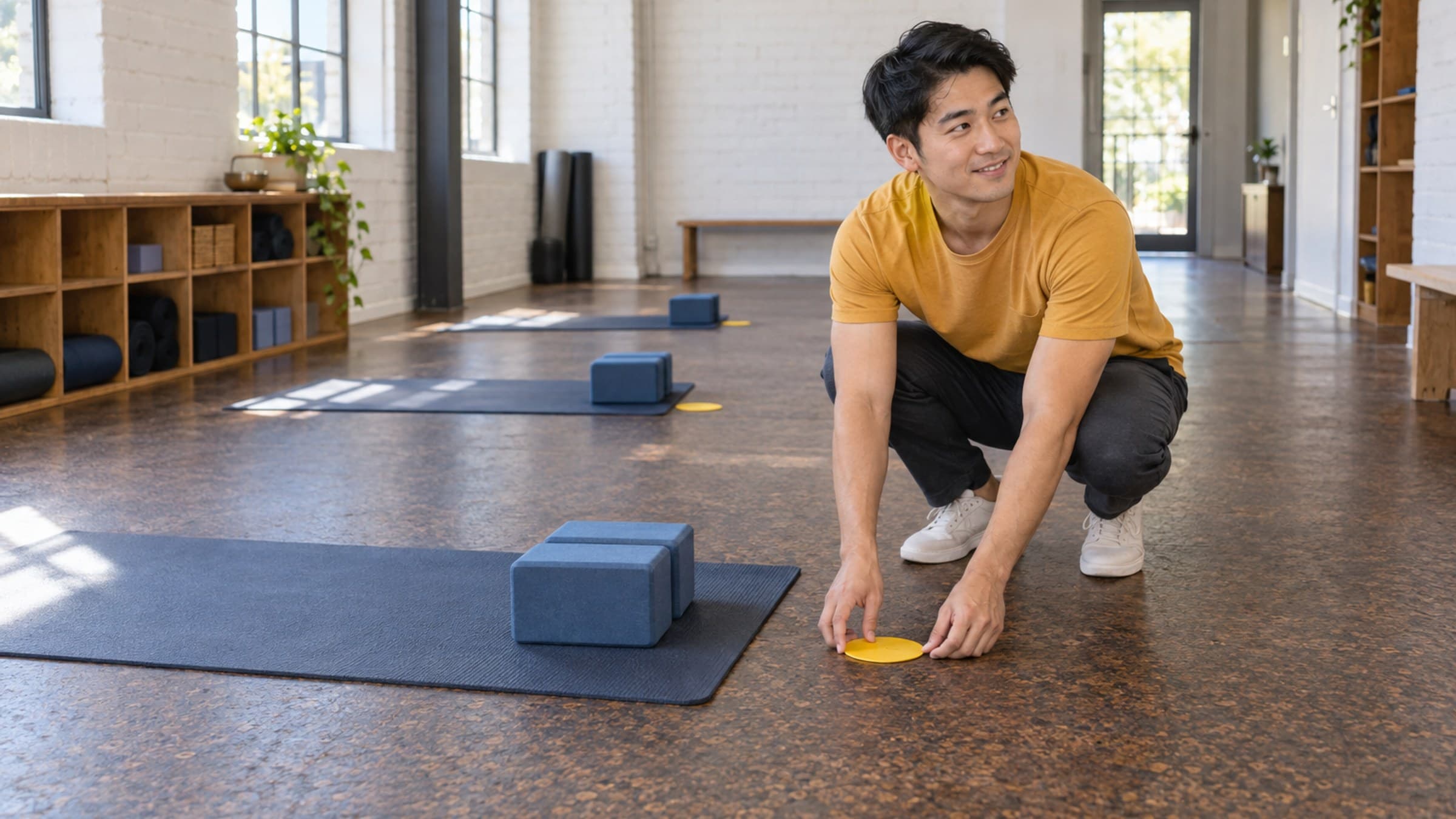
- Set out the room before the first new client arrives.
- Have the instructor near the entrance during the arrival window.
A prepared room is especially helpful when the regular clients know the routine. Familiar people will naturally move quickly, claim their usual places, and begin talking to each other. The new person should not have to interrupt that rhythm to ask where a mat belongs.
Give the instructor a simple first-minute routine
The first welcome does not need to be elaborate. It should make the person feel noticed without putting them on display.
Use the same small routine for every new client:
- greet them by the name they use;
- introduce yourself;
- point out where belongings and equipment go;
- explain what will happen in the first few minutes; and
- offer a private chance to share a practical need.
You might say:
Hi Morgan, I am Alex. You can leave your bag on the hooks and choose any open spot. I will begin with a short orientation for everyone. If there is anything practical you want me to know before we start, we can speak over here.
Do not ask a new client to explain an injury, diagnosis, or accommodation in front of the class. If you need information for safe participation, make space for a private conversation and record it only where it belongs.
Keep the attendance list ready
Before the doors open, know who has booked and how many places remain.
This prevents an awkward search at the entrance and helps you respond consistently to drop-ins. If the class is full, decide in advance whether you ever accept an extra person. Do not change the capacity because someone is already standing in front of you unless the room, equipment, supervision, and your policy genuinely allow it.
Your attendance check can be brief:
| Moment | What to confirm | | --- | --- | | Before class | Expected names, first-time clients, available places | | At the door | Who arrived and whether anyone needs private help | | After class | Attendance, cancellations, and any follow-up you promised |
Keep the list practical. The instructor needs to know who is expected, not read every detail in a client record while people are arriving.
Explain choices without singling anyone out
Clients are more likely to use an easier, quieter, or more supported option when you offer it to the whole room.
Instead of waiting for one person to struggle, explain the choices before the activity begins: "You can do this standing or seated," or, "Use the wall if you would like more support."
That approach helps a first-time client participate without having to announce why they chose an option. It also reminds regular clients that choosing a different version is a normal part of the class, not a sign that someone is failing.
Be equally clear about stepping out. Tell the group where they can take a break and how to rejoin. A client should not have to choose between staying in discomfort and making a conspicuous exit.
Ask one useful question after class
At the end, avoid asking a new client to review the whole experience while everyone is packing up. One small question is easier to answer honestly:
Was there anything about arriving or getting started that was unclear today?
This keeps the feedback focused on something you can improve. If several people mention the entrance, equipment, or arrival time, fix the confirmation message or room setup rather than explaining the same thing one person at a time.
You can also tell the client what comes next without pushing for another booking: where the next class appears, whether the schedule repeats, and how to contact the practice with a question.
Stillpoint's group class tools let you schedule one-off or recurring classes, set capacity, and track enrollment. Its appointment reminders can carry the concise arrival details clients need before they leave home. The software can hold the logistics so your in-person welcome stays simple and human.