
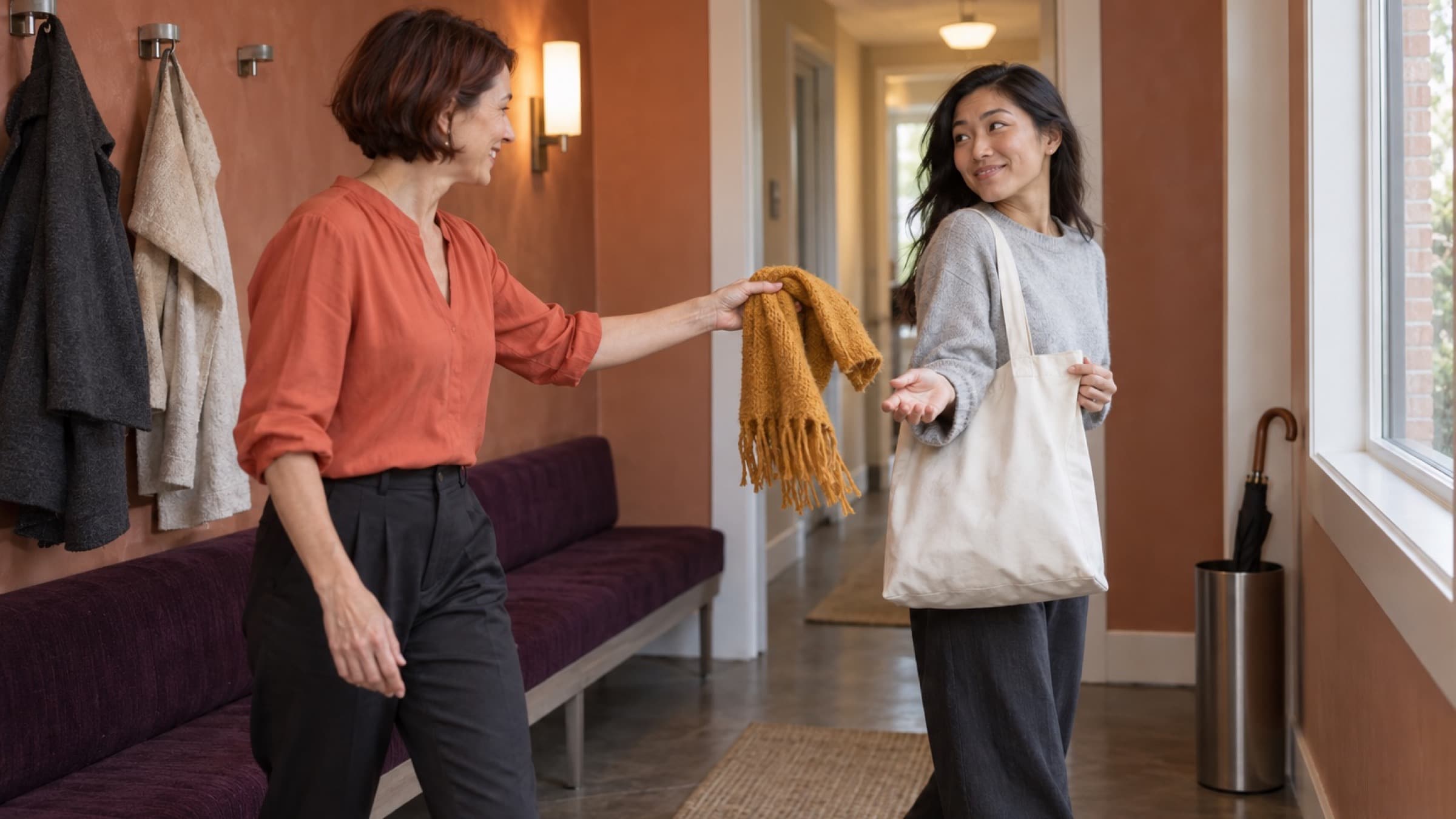
Pause before deciding who it belongs to
You may feel certain that the blue scarf belongs to the client who just left. Certainty is not the same as verification.
Another client may have used the room earlier. A colleague may have set something down while resetting the space. An item near the front door may belong to a courier, visitor, or person from a neighbouring business.
Start with what you actually know:
- what the item is;
- where it was found;
- when you noticed it; and
- which people were in that area recently.
Do not send the item to someone based only on a quick assumption. If you contact a likely owner, ask them to describe what they left before giving identifying details yourself.
This matters most for wallets, keys, medication, identification, assistive devices, and anything that may contain personal information. Put those items somewhere secure while you confirm the owner. If the item could create an immediate safety or access problem, use the practice's established urgent-contact process rather than improvising one.
Move it to one secure place
A forgotten item is easy to lose twice.
Someone puts it behind reception. Another person moves it to a treatment room. A third person answers the client's message but cannot find what everyone remembers seeing.
Choose one secure lost-item location for the practice. It might be a closed cabinet in a staff-only area or a small bin inside a locked office. It should be accessible to the people who handle pickup, but not visible or reachable from the waiting room.
Keep valuable, sensitive, or potentially hazardous items separate from ordinary clothing and umbrellas. Follow any professional, building, or local requirements that apply to medication, identification, keys, or other sensitive property. When you are unsure, ask the appropriate authority or professional body rather than making up a disposal rule.
The location does not need to be elaborate. It needs to be consistent. If everyone knows where found items go, nobody has to search the practice while the owner waits at the door.
Record the minimum useful detail
The record should help your team return the item without becoming a second privacy problem.
Write down the date, the general item type, where it was found, and who secured it. If someone has already made contact, add the agreed pickup plan and the person responsible for the handoff.
Avoid copying clinical details, appointment notes, or a long explanation of why you think the item belongs to a particular client. A task called "Arrange pickup of item found in Room 2" may be enough. The client record can hold the appropriate contact history if your process requires it.
Be especially careful with descriptions that reveal something the client may not want repeated. A message preview on a shared device can expose more than you intended. "You left an item at the practice" is often safer than naming medication, identification, or another sensitive object before you know you are speaking with the owner.
Send one calm message
When you have a likely owner, contact them through the usual practice channel. Keep the first message short.
Hi, this is Rowan Practice. We found an item after your visit today that may be yours. Please reply or call us when you have a moment so we can confirm it and arrange pickup.
The message says what happened without putting identifying details into a notification preview. It also gives the person room to answer without making the situation sound urgent when it is not.
If the item is time-sensitive, say what is true. A set of keys may affect whether someone can get home. A phone may be the person's only way to contact you. A necessary assistive device may need a faster plan. Use the contact methods the client has agreed to, and do not send repeated messages across every channel simply because the first one was not answered immediately.
If you do not know who owns the item, avoid messaging a group of recent clients. A broad "did anyone leave this" note can reveal who attended the practice and can invite competing claims. Secure the item and wait for the owner to contact you, unless your established policy provides another appropriate route.
Make pickup specific
"Come by whenever" sounds flexible, but it creates uncertainty for both sides.
Give the owner a clear window when someone will be available. Mention the entrance they should use if your practice has more than one. If reception is not continuously staffed, ask them to confirm a time before coming.
Decide how your team will verify the handoff. For an ordinary scarf or water bottle, a matching description may be enough. For a wallet, keys, identification, or valuable equipment, use a stronger check that fits the situation. Do not leave a valuable item outside, in an unlocked mailbox, or with a neighbouring business simply because that feels convenient.
Sometimes another person will offer to collect it. Ask the owner to name that person in advance and decide what confirmation you need at pickup. The goal is not to make the handoff formal for its own sake. It is to avoid giving someone's property to the first person who asks confidently.
When the item is collected, close the loop. Mark the follow-up complete and remove any temporary label or note you no longer need.
Set a reasonable holding rule
Without a holding rule, one shelf can slowly become a permanent collection of water bottles, earrings, chargers, and umbrellas.
Choose a review interval and a disposal or donation approach that fits the item and your local obligations. Ordinary low-value items may follow one timeline. Identification, keys, medical items, records, and valuables may require a different process. Put the rule in your staff procedure and check it against any professional, insurer, landlord, or local requirements that apply to your practice.
Tell the owner about a deadline only when you can follow it consistently. Do not threaten disposal in the first message when a simple pickup is already being arranged. The rule is there for genuinely unclaimed property, not to make a forgetful client feel scolded.
Schedule a short monthly check of the lost-item location. Confirm which items are still waiting, whether contact has happened, and what the next appropriate step is. A regular check prevents valuable property from disappearing behind a stack of supplies for six months.
Add a room sweep to the handoff
The easiest item to return is the one you notice before the client leaves.
Build a quick visual sweep into the end of each appointment. Check the chair, hooks, floor, washroom route, and any surface where a client may have set down a phone or glasses. You can do this while the client puts on their coat or while you walk together toward reception.
Keep the tone light if you spot something.
I think this scarf came in with you.
That is enough. You do not need to turn the moment into a reminder about being careful.
If forgotten items keep appearing in the same place, change the environment. Add a visible hook near the treatment chair. Move the umbrella stand closer to the exit. Give clients one obvious place for bags and phones instead of several small surfaces around the room.
Keep the next step out of your head
A left-behind item is usually easy to return. The part that creates friction is the unfinished follow-up: who sent the message, when pickup is expected, and whether the item is still waiting.
Use one secure place for the item, one careful message, and one named owner for the next step. That is enough to make the process feel considered without making it heavy.
Stillpoint Tasks can give the pickup follow-up an assignee and due date, then mark it complete once the item is returned. It is a small use of a shared task list, but it keeps a client's property from becoming one more thing the whole team assumes someone else handled.