
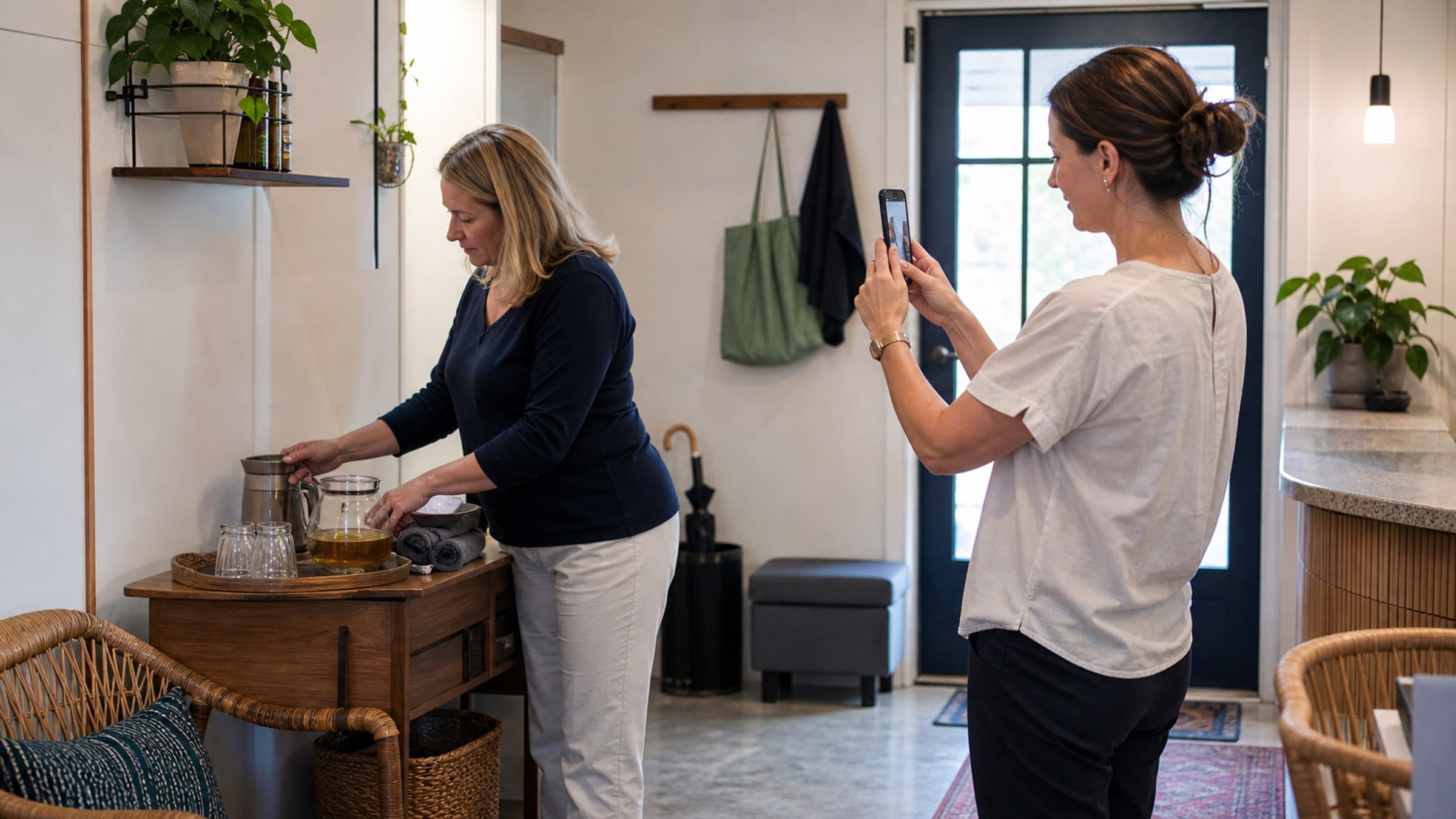
Decide what the post is for
Before you write the first sentence, choose one job for the post.
It might:
- teach one small, useful idea;
- explain what a client can expect;
- show how your space or schedule works;
- answer a question you hear often;
- share a real opening in the calendar; or
- remind people of a service they may not know you offer.
One post does not need to introduce you, explain your approach, prove your expertise, describe every service, and ask for a booking. When it tries to do all of those things, it usually reads like a brochure.
Pick the single thing you want a person to understand when they finish reading. If that thing is clear, the post has done its job even if they do not book today.
Start with a moment people recognize
Broad advice is easy to scroll past. A familiar moment gives someone a reason to keep reading.
Instead of starting with "Massage has many benefits," you might start with the client who arrives straight from work and realizes their shoulders are still up near their ears. Instead of "Remember to prioritize self-care," you might describe the five quiet minutes between closing a laptop and leaving for an appointment.
The moment does not need to come from a particular client. In fact, it usually should not. Use a common situation you see across your work, with details changed or generalized so nobody can recognize themselves.
Then offer one practical next step. You could explain what to wear, when to arrive, what information to bring, or how to tell a practitioner that something feels uncomfortable. Useful specifics sound more trustworthy than a large promise because the reader can act on them right away.
Describe the experience, not a guaranteed outcome
Wellness language can become too certain very quickly.
"This treatment will fix your pain" is a promise you cannot make for every person. "This treatment may help with pain" is more careful, but it can still be too vague to teach anyone much.
Talk about what is actually within your control:
- how you begin the appointment;
- what choices a client can make;
- what the room is like;
- how you adjust pressure, pace, or positioning;
- what you ask before starting; and
- what follow-up information you provide.
For example: "We start with a short check-in about what has changed since your last visit. You can ask to focus on one area, change the plan, or leave something out."
That is concrete without predicting a result. It also helps a potential client understand how much agency they will have in the room.
Let ordinary practice details do the work
You do not need a dramatic client story to make a post feel personal.
The ordinary details of your practice are often more useful: where wet coats can go, whether a client should remove their shoes, how early the front door opens, what happens if they need a scent-free room, or why you leave space between appointments.
These details show care without requiring you to say that you care. They also answer the small questions that can make a first visit feel harder than it needs to.
Keep a note of the questions people ask by phone, email, and at reception. When the same question appears twice, it may be a good post. You already know the language because you have answered it in conversation.
Write the answer as if you were replying to one thoughtful person, not addressing an audience. That usually brings your natural voice back.
Keep client stories on the client side of the boundary
A moving client story may feel like strong content. It is also where a useful post can become too revealing.
Removing a name is not always enough. A diagnosis, occupation, unusual injury, appointment date, or family detail can make someone recognizable to themselves or to people who know them. Even a positive result can expose something the client did not expect to see in public.
If you want to share a review or testimonial, get clear permission for that specific public use. Permission to collect a review for your website does not automatically answer whether it can be reused on social media. Record the permission, respect any limits, and make it easy for the client to change their mind.
For everyday educational posts, you rarely need a client story at all. Combine patterns, remove identifying details, and make the lesson the subject. Your insight can be specific without making a person visible.
Share an opening without creating panic
An open appointment is useful information. It does not need a countdown, a discount, or a warning that someone will miss out.
State the day, the service if relevant, and the simplest way to see whether the opening is still available. Keep the wording calm:
A few appointments are open on Thursday. If you have been meaning to come in, you can check the current times through the booking link.
This works because it stays true even as individual times are booked. It also sends people to the live schedule instead of asking them to claim a time through comments or public messages.
Avoid posting sensitive scheduling conversations in public. If someone asks a personal question in a comment, move the conversation to an appropriate private channel without asking them to explain their health or circumstances first.
Give the reader one next step
Many posts lose their calm voice in the final line. The body is useful, then the ending suddenly asks the reader to book, follow, share, comment, and send the post to a friend.
Choose one next step, and only include it when it fits the post.
For an educational post, the next step may simply be to save the idea for later. For a first-visit explanation, it may be to read more about the service. For an availability post, it may be to check the booking page. Some posts do not need a call to action at all.
A quiet ending gives the useful part of the post room to land. You do not have to turn every moment of attention into a transaction.
Build a small set of themes you can repeat
You do not need a brand-new content strategy every morning. Choose three or four themes that reflect how your practice actually works.
For example:
- What to expect before, during, or after an appointment.
- Small choices that help clients feel informed and comfortable.
- Answers to common practical questions.
- Current services, schedule changes, or genuine openings.
Return to those themes with different details. Repetition is not a failure. Most people will not see every post, and the ideas that matter most should sound familiar over time.
You can also keep a short list of moments worth explaining. Add to it when a client asks a good question, when you change a process, or when you notice something that would have helped a first-time visitor. Then the next post begins with a real subject instead of an empty caption box.
Write like the person clients already meet
The best practice voice is usually not invented. It is the voice you already use when you explain something clearly, set a kind boundary, or help someone know what happens next.
Choose one job for the post. Begin with a recognizable moment. Stay specific about the experience and careful about outcomes. Protect client details. Then offer one proportionate next step, if the post needs one.
Stillpoint's public booking page gives people one place to see your current services and available times. If you share an opening, point people to that live schedule so the post can stay simple and the booking details stay current. If the blank caption box is the hard part, start with one true detail and keep the final say.